
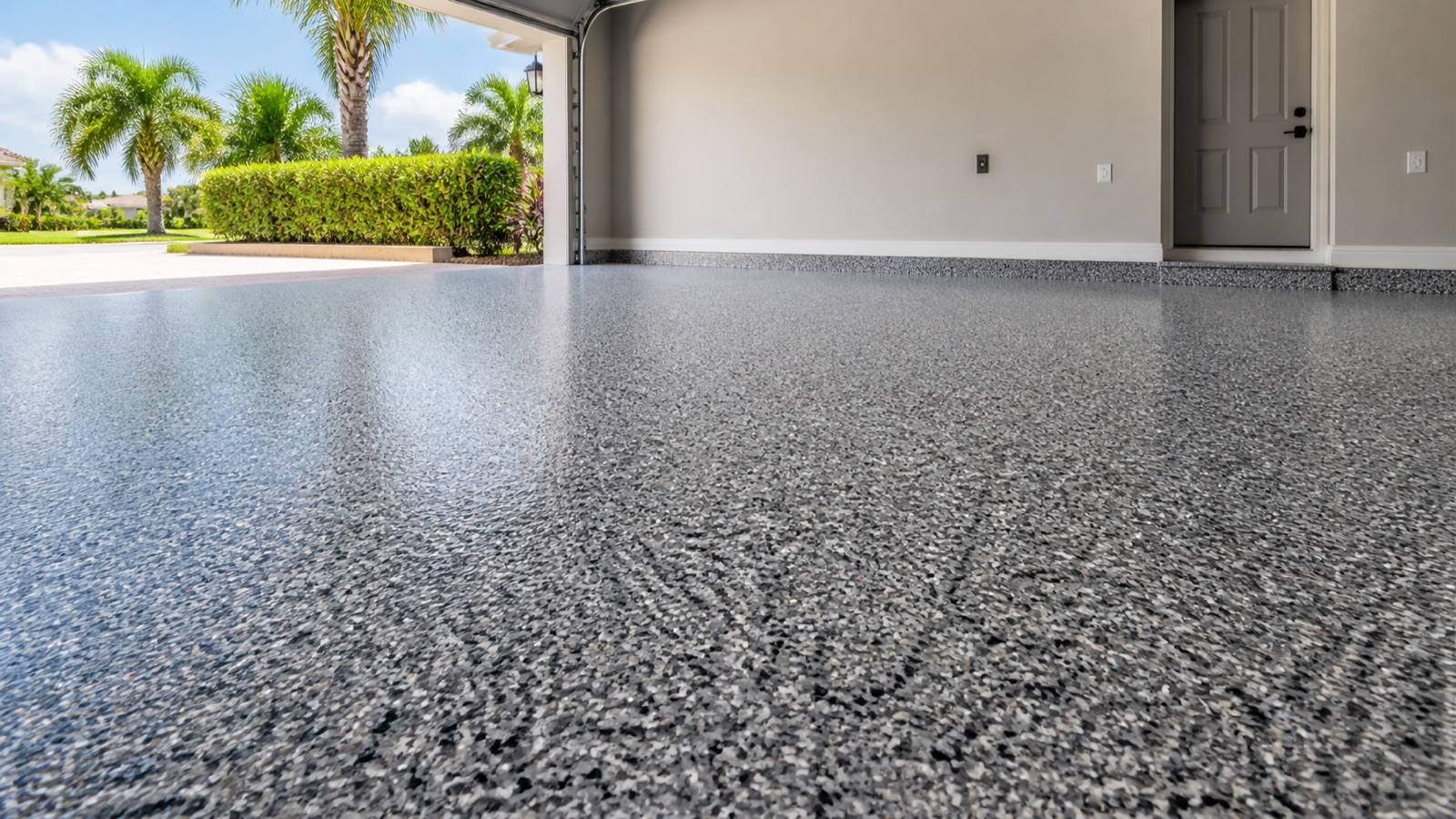
Is polyaspartic a good choice for Tampa Bay garages?
A polyaspartic garage floor can be an excellent choice in Tampa Bay when it is part of a properly designed system installed over mechanically prepared concrete. Polyaspartic topcoats cure quickly, resist ultraviolet discoloration, tolerate common garage chemicals, and protect a decorative flake broadcast. Those advantages fit Florida garages that receive intense sun, heat, humidity, rainwater, and daily vehicle traffic.
The important qualification is “properly designed.” Polyaspartic is a chemistry, not a guarantee. A fast-cure product applied over smooth, damp, contaminated, or weak concrete can fail. Many successful systems combine a moisture-tolerant or high-build epoxy base, a full flake broadcast, and a UV-stable polyaspartic clear coat. Each layer does the job it handles best.
Tampa homeowners should evaluate the slab before choosing the sales label. Coastal moisture, older concrete, flood history, irrigation, cracks, and previous coatings can change the preparation or primer. A reputable installer will inspect the garage, test or assess moisture risk, specify the layers, and explain cure conditions. Homeowners should also verify warranty language for hot tire pickup, peeling, and delamination.
In short, polyaspartic is valuable because of its performance as part of a complete process. The floor lasts because the concrete, preparation, repair, material selection, application, and cure schedule all support one another.
How does Tampa Bay heat affect garage coatings?
Tampa Bay heat affects the slab, tires, products, and installation window. A closed garage can become much hotter than the outdoor forecast, and sun near the open door can create a large surface-temperature difference across one floor. Tires absorb roadway heat and transfer it to the coating after parking. Daily heating and cooling create expansion and contraction in the concrete.
Hot tire pickup occurs when softened or poorly bonded coating sticks to a warm tire and lifts as the vehicle moves. Proper mechanical preparation and compatible industrial materials reduce that risk. The coating must bond within the concrete profile rather than sitting on a dense, lightly etched surface. Adequate film build and cure also matter. A written warranty that specifically addresses hot tire pickup is more meaningful than a general promise of durability.
Heat changes application behavior too. Fast-curing products can lose working time quickly on a warm slab. Experienced crews plan mixing, batch size, manpower, ventilation, and application sequence around measured conditions. “One day” is not automatically better if speed sacrifices repairs, moisture evaluation, or controlled application.
UV exposure is another Florida concern. Conventional aromatic epoxy can amber where sunlight reaches through an open garage door. A UV-stable aliphatic polyaspartic topcoat provides better color stability. It still must be applied at the correct coverage rate over a compatible system. Tampa homeowners should ask which layer receives direct sunlight and exactly what product protects it.
What role does humidity and moisture play?
Humidity in the air and moisture moving through concrete are related but different. High outdoor humidity can influence application and cure conditions. Moisture vapor transmission comes from below or within the slab and may continue even when the surface appears dry. In Tampa Bay, high water tables, heavy rain, drainage issues, older vapor barriers, and conditioned interiors beside hot garages can all affect moisture behavior.
Moisture vapor can create bubbles, whitening, loss of adhesion, or pressure beneath an impermeable coating. That does not mean every Tampa slab needs an expensive mitigation system. It means the risk should be evaluated instead of ignored. The installer may use visual inspection, moisture meters, relative-humidity testing, or other methods appropriate to the project and product requirements.
Water entering from the driveway is a separate issue. Wind-driven rain and poor threshold drainage can leave standing water on top of the coating. A quality topcoat handles occasional water, but exterior drainage should still direct water away. Texture is important because a wet glossy floor can be slippery. Discuss traction additive and the family’s walking path through the garage.
Watch for efflorescence, persistent dark areas, previous blistering, musty conditions, or water after storms. Tell the estimator about past flooding and plumbing leaks. Concealing that history helps no one. A coating installer can adapt the primer or recommend corrective work, but the system should not be presented as a cure for active water intrusion or structural drainage problems.
How much does a polyaspartic garage floor cost in Tampa?
A professionally installed coating system for a standard two-car Tampa garage commonly costs about $2,900 to $4,800, with projects generally starting near $2,000. The exact total reflects square footage, slab condition, coating removal, crack repair, moisture treatment, vertical surfaces, finish selection, and the number and type of coats. Larger three-car garages and combination garage-workshops naturally require more material and labor.
Be careful with a single square-foot price advertised without a scope. One estimate may include diamond grinding, edge work, repairs, full decorative flake, a UV-stable topcoat, cleanup, and a lifetime warranty. Another may cover only a thin direct-to-concrete coat. Both can be described online as “polyaspartic,” but they are not equal projects.
Ask the estimator to separate optional items and identify assumptions. Will cabinets remain? Are stem walls, stairs, and the apron included? Is failed paint removal priced? What happens if hidden contamination is discovered? When is final payment due? A professional proposal should help the homeowner understand price changes before work begins.
Value should be measured over the expected service life. A low-cost coating that peels may require removal before it can be replaced, adding cost and inconvenience. A properly prepared system costs more initially because grinding, dust control, repairs, skilled labor, and industrial material are real inputs. Compare warranties, local reviews, and exact layer specifications along with the price.
Should the base coat also be polyaspartic?
Not necessarily. Some complete polyaspartic systems perform well, and some hybrid systems use epoxy below a polyaspartic topcoat. The correct choice depends on the products, slab, working conditions, cure schedule, and installer’s tested process. Homeowners should resist oversimplified claims that one chemistry is always best in every layer.
Epoxy base coats are often valued for adhesion, high build, and working time on a prepared slab. Polyaspartic topcoats are valued for rapid cure, UV stability, abrasion resistance, and chemical protection. A full flake broadcast becomes the mechanical bridge between layers and creates the decorative surface. In a thoughtfully specified hybrid, the homeowner receives the complementary benefits of each material.
A direct-to-concrete polyaspartic base can also be appropriate when the manufacturer’s system, moisture conditions, profile, and crew timing support it. Problems arise when fast cure becomes the primary sales benefit and the preparation schedule is compressed. Repairs need time and correct material. The slab needs a consistent profile. Edges must receive attention. Application teams need enough labor to maintain a wet edge.
Ask for product data, not just generic names. Find out who manufactures the base and topcoat, whether the layers are approved together, and what cure windows apply. If the answer is simply “poly is better than epoxy,” request more detail. The system should be chosen because it fits the garage, not because one word is easier to advertise.
What does diamond grinding accomplish?
Diamond grinding removes weak surface material, opens dense concrete, addresses minor contamination, and creates a consistent texture for coating adhesion. Professional grinders use rotating diamond tooling selected for the hardness and condition of the slab. Connected dust collection captures most airborne material, while edge equipment reaches the perimeter and corners.
The desired result is a concrete surface profile appropriate for the coating system, often described in CSP terms. A profile that is too smooth provides limited mechanical key. Excessively aggressive removal can expose aggregate or damage the slab unnecessarily. The installer evaluates the result as work progresses instead of treating every floor identically.
Grinding also reveals hidden conditions. Old repairs may loosen, oil can extend deeper than expected, and small cracks may become visible after the surface is clean. Those discoveries should be repaired before coating. Vacuuming is critical because loose dust interferes with bond. The base coat should contact sound prepared concrete, not a layer of powder.
Acid etching changes the surface chemically but does not provide the same removal, control, or visibility. It may leave salts or react unevenly on power-troweled and contaminated areas. For a long-term Tampa garage floor, ask whether the entire slab and edges will be mechanically prepared. The answer explains more about likely durability than a display board showing color flakes.
How long does installation and curing take?
Most residential garage coating projects take one or two working days, with additional cure time before vehicles return. The schedule depends on surface condition, removal, repairs, moisture mitigation, layer chemistry, temperature, and humidity. Polyaspartic products can cure quickly, but the entire project still includes preparation and inspection that should not be rushed.
Before installation, remove vehicles, storage, shelves that touch the floor, refrigerators if requested, and loose wall items vulnerable to dust. Confirm where belongings can remain and how the crew will access electrical power. Plan for driveway or street parking according to local rules. Pets and children should stay away from the work zone while products are applied and curing.
After coating, follow written return-to-service milestones. Foot traffic may be permitted before heavy storage, rolling tool chests, or vehicles. Tire placement concentrates weight and heat, so the vehicle date matters. Humid or cool conditions can adjust the schedule even when a product is marketed as fast curing.
Rapid return to service is useful, but durability has higher value than shaving a few hours. A trustworthy installer will delay vehicle traffic when conditions require it. Homeowners should also avoid washing the floor or placing rubber-backed mats until the system has cured as directed. Good scheduling protects the investment and prevents marks that have nothing to do with long-term coating quality.
Which finish and traction level should you choose?
Gray, charcoal, black-and-white, and neutral stone blends are popular in Tampa Bay because they fit many home styles and hide typical dust and tire debris. Lighter floors brighten a garage but may show dark marks. Very dark floors look dramatic but reveal pale sand, grass, and salt residue. A mixed full-broadcast pattern is forgiving for everyday use.
Evaluate physical samples on the actual garage floor near the open and closed door. Florida sunlight can make a blend look much lighter than it appears indoors. Consider cabinet colors, wall paint, vehicle colors, and the view from adjoining living space. If resale matters, balanced neutral selections appeal to more buyers than a highly personal color.
Traction must account for rain. A smoother clear coat is easy to mop but can be slippery when wet. A heavier texture improves grip yet holds dirt and makes cleaning harder. Ask the installer to explain aggregate options and show a cured sample, not just loose flakes. Households that walk through the garage, wash cars inside, or store pool equipment may prefer more texture.
The topcoat should fully encapsulate the prepared flake while preserving the intended profile. Thin spots around edges or door transitions reduce protection. Inspect those areas during the final walkthrough. The best finish is visually consistent, comfortable to walk on, practical to clean, and suited to how the garage is actually used.
What should a Tampa Bay warranty cover?
A garage floor warranty should state who provides service, what failures are covered, how long coverage lasts, and what conditions are excluded. For Tampa use, ask specifically about hot tire pickup, peeling, delamination, and UV-related discoloration of the topcoat. Confirm whether labor and materials are both included and whether the warranty transfers to a future homeowner.
Some exclusions are reasonable. Coatings cannot prevent structural cracking, stop hydrostatic water pressure, or survive every chemical spill and impact. Damage from dragging metal, welding, battery acid, or unprotected jacks may fall outside normal use. The installer should explain these boundaries in plain language and recommend protective practices.
Keep the contract, product care sheet, photographs, and finish information. If lifting, bubbles, whitening, or unusual discoloration appears, notify the installer promptly. Do not sand, dissolve, or patch the area before inspection. Early documentation helps distinguish installation issues from new slab or water conditions.
Company stability matters. Reviews should show consistent local work and evidence that warranty questions are answered. Ask who schedules inspections and how long service normally takes. A warranty is not merely a line on a sales page; it is a service commitment that should be easy to understand before the homeowner pays a deposit.
How can you compare Tampa Bay coating contractors?
Start with comparable written scopes. Every proposal should identify preparation, dust control, crack repair, moisture evaluation, base coat, flake coverage, topcoat, vertical surfaces, cure schedule, cleanup, price, and warranty. When one price is much lower, determine which of those items differs. Do not accept “same system” without product and process details.
Ask to see local completed projects and recent reviews. Tampa Bay garages range from older slabs near the coast to newer master-planned communities, and the installer should recognize how age, finish, moisture, and previous coatings change the plan. Confirm insurance and who will actually perform the work. A polished salesperson does not replace an experienced crew.
Use four direct questions: Will you diamond-grind the whole floor and edges? How do you evaluate moisture? What are the exact base and topcoat products? Does the written warranty cover hot tire pickup and delamination? Strong contractors answer without evasion. They will also tell you when a slab needs extra work rather than promising a universal one-day solution.
Granite Garage Floors serves Tampa Bay with professional assessment, diamond grinding, industrial-grade epoxy and polyaspartic materials, full-broadcast decorative finishes, and a Lifetime Satisfaction Warranty. Review the Tampa service page, compare coating types, and request a free in-garage estimate. A local inspection turns broad online advice into a specific plan for the concrete, schedule, finish, and budget in your home.
Frequently Asked Questions
Is polyaspartic better than epoxy for a Tampa garage?
They perform different jobs well. Many durable systems use epoxy as a high-build base and UV-stable polyaspartic as the protective topcoat. The preparation, product compatibility, moisture conditions, and workmanship matter more than choosing a marketing label.
Can polyaspartic coating handle hot tires?
A properly installed industrial system over diamond-ground concrete is designed to resist hot tire pickup. Verify that the written warranty specifically covers hot tire pickup rather than relying on a general durability claim.
Will Tampa humidity prevent garage floor coating?
No, but humidity and slab moisture must be considered. The installer should evaluate conditions, select compatible products, and use moisture mitigation when testing or slab history indicates it is necessary.
How soon can a car park on polyaspartic flooring?
Timing varies by product and conditions. Foot traffic may be allowed earlier, while vehicles usually require a longer cure. Follow the installer’s written schedule; fast cure does not mean immediate vehicle service.
How do I clean a polyaspartic garage floor?
Sweep grit regularly, clean with water and a mild pH-neutral product, and wipe chemical spills promptly. Avoid abrasive powders and unapproved solvents. Use pads under jacks and sharp concentrated loads.
Get a free estimate from our Orlando team. No pressure, no obligation — just honest advice and a firm quote.
Request Free Estimate →