
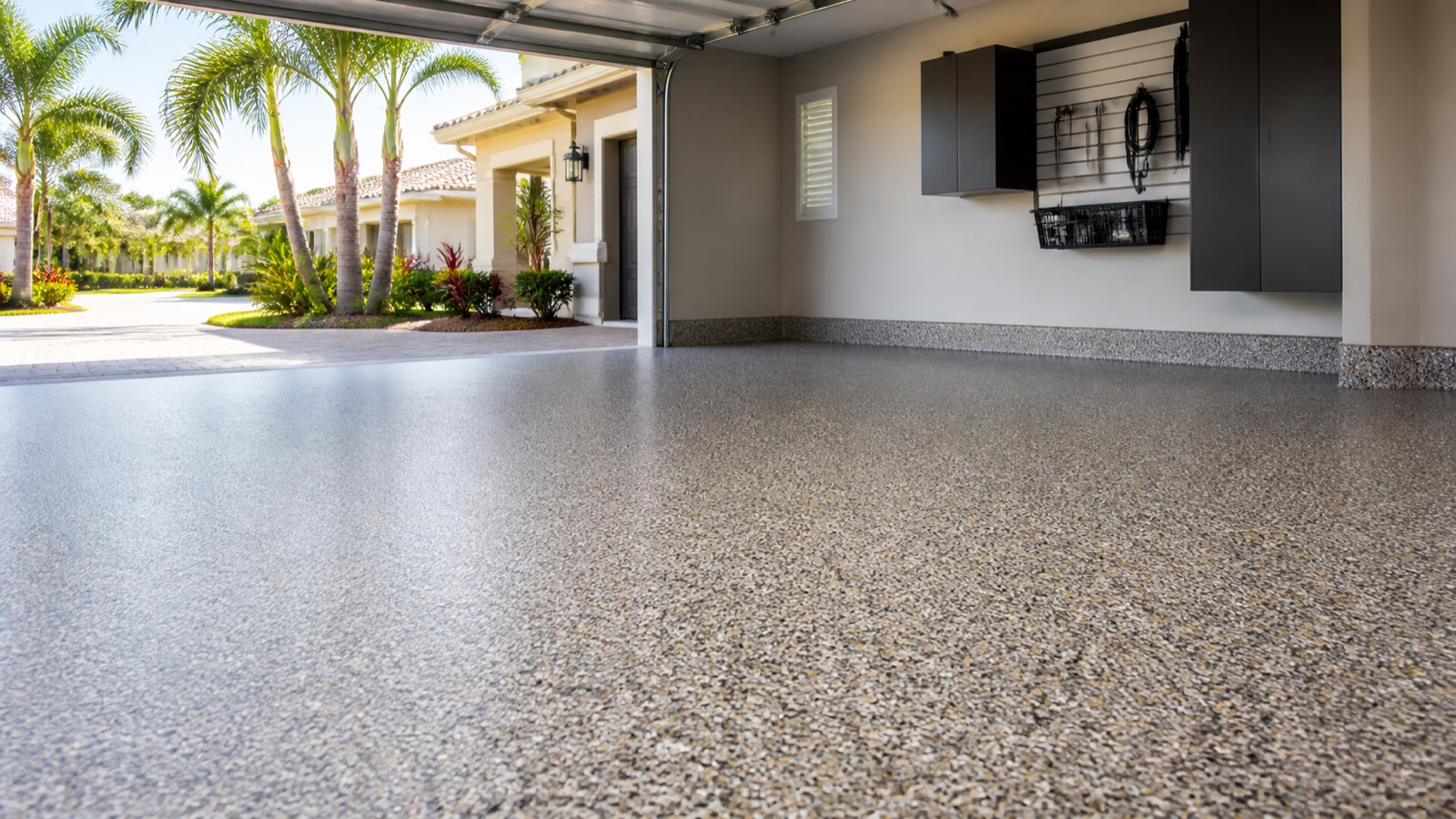
What should Winter Garden homeowners know first?
A professional garage floor coating in Winter Garden, FL should be treated as a complete flooring system, not a can of paint. The result depends on the concrete assessment, mechanical preparation, crack repair, moisture testing, base coat, decorative broadcast, topcoat, and cure schedule working together. If one step is skipped, even a premium-looking floor can peel, blister, discolor, or lift under hot tires.
For most homeowners, the useful starting point is simple: expect a professional installer to inspect the slab in person, explain the exact layer system, mechanically diamond-grind the concrete, and provide written warranty terms. A standard two-car garage commonly falls in the $2,900 to $4,800 range, while repairs, moisture mitigation, stem walls, steps, cabinets, or premium finish choices can change the total. Projects typically start around $2,000.
Winter Garden garages experience heat, humidity, wind-driven rain, lawn chemicals, road grit, and hot tires. Newer Horizon West homes can also have very smooth machine-finished slabs that need proper profiling. The right question is not simply “epoxy or polyaspartic?” It is whether the complete system is matched to the slab and installed under controlled conditions. That is what creates a floor that stays attractive and easy to maintain for years.
How much does garage floor coating cost in Winter Garden?
A standard two-car garage floor coating in Winter Garden generally costs about $2,900 to $4,800 for a professionally prepared, multi-layer system. Three-car garages, workshops, oversized drive bays, and garages with extensive repairs cost more because the installer uses more labor, grinding time, repair material, flake, and topcoat. A low advertised square-foot number may exclude the details that actually determine the finished price.
Square footage is only the first factor. Installers also evaluate cracks, control joints, spalling, old paint, oil contamination, moisture vapor, vertical edges, stairs, and the amount of equipment that must be moved. Removing a failed coating is slower than preparing bare concrete. Moisture mitigation may add a specialized primer. Decorative metallic systems demand different labor than a full-broadcast flake floor. A firm quote should identify these items instead of presenting one unexplained total.
When comparing prices, ask whether diamond grinding, dust collection, crack repair, moisture testing, full flake coverage, the clear topcoat, cleanup, and the warranty are included. A cheaper estimate that leaves out surface preparation or uses a thin water-based kit is not equivalent. Compare the installed system and the written scope, not just the final dollar amount. For a quick local baseline, review the Winter Garden service page and the detailed Orlando-area cost guide before scheduling an in-garage estimate.
Why do Central Florida slabs require special preparation?
Central Florida concrete is exposed to conditions that make preparation especially important. Humidity and a high seasonal water table can move moisture vapor through a slab even when the surface looks dry. Summer temperatures heat tires and concrete, while afternoon storms can rapidly change the garage environment. These conditions do not automatically prevent coating, but they make guessing risky.
A professional assessment looks for visible dampness, efflorescence, dark spots, previous coating failure, hollow or weak concrete, oil penetration, cracks, and drainage concerns. Moisture testing helps determine whether a standard primer is appropriate or whether mitigation is needed. The installer should also consider the slab’s age and surface finish. Dense, power-troweled concrete can resist penetration until it is mechanically opened.
Acid washing is not a substitute for mechanical profiling. Acid can react unevenly, leave residue, and fail to remove weak surface material or old coatings. Diamond grinding physically removes contamination and creates a consistent concrete surface profile. Edge grinders should reach walls, corners, and transitions so those areas bond as well as the center of the floor. Effective dust collection keeps the garage and adjoining rooms cleaner.
Preparation is not the glamorous part of a garage makeover, but it is the foundation. Decorative flakes and gloss cannot compensate for a weak bond. Homeowners should be comfortable asking exactly how the slab will be prepared and what condition the installer expects before applying the first liquid layer.
Which coating system works best in Winter Garden?
For many Winter Garden homes, a hybrid system provides the best balance: a high-build industrial epoxy base coat for adhesion and body, a full decorative flake broadcast, and a UV-stable polyaspartic clear topcoat. The layers have different jobs. The base coat bonds to properly profiled concrete, the flakes create the finished appearance and texture, and the topcoat protects the surface from sunlight, chemicals, abrasion, and cleaning.
The word “epoxy” is often used to describe every garage coating, but formulations vary widely. A thin, water-based DIY kit is not equivalent to a 100% solids professional base. Likewise, polyaspartic is not automatically superior in every layer. Its fast cure and UV stability make it useful as a topcoat, while a slower-curing base can provide working time and dependable wetting of the prepared slab. Product choice should support the installation process, not a marketing slogan.
Ask the contractor for the manufacturer and product type of each coat, the expected cured thickness, and the return-to-service schedule. Also ask whether the clear coat is UV stable and whether traction additive can be adjusted. Garages that receive direct afternoon sun need a topcoat that resists yellowing. Homes used as workshops may benefit from additional texture, while homeowners who regularly sweep and mop may prefer a balanced finish that is not excessively aggressive.
The best system is the one installed correctly over a dry, sound, properly profiled slab and backed by clear workmanship and product coverage.
What happens during the professional installation?
A well-run installation begins before the crew starts grinding. The garage should be emptied according to the contractor’s instructions, and the team should confirm the scope, finish, repairs, vertical surfaces, and access plan. The slab is inspected again after everything is removed because storage and vehicles can hide cracks, stains, and previous repairs.
During preparation, industrial grinders open the concrete and remove weak material. Handheld edge equipment addresses the perimeter. Cracks and surface defects are cleaned and repaired with materials selected for the movement and depth involved. The crew vacuums carefully and verifies that the surface is ready. If testing shows a moisture concern, the specified mitigation step is installed rather than ignored.
The coating stage normally includes the base layer, decorative flake broadcast, removal of loose excess flake, scraping or sanding to achieve the intended texture, detailed vacuuming, and the protective clear topcoat. Coverage around door thresholds, steps, and stem walls should look intentional. Weather, temperature, and product cure windows guide the schedule.
Many professional systems are completed over one or two working days, but “fast” should not mean rushed. Cure times control when people may walk on the floor, when light items may return, and when vehicles can park. Follow the written instructions. Parking too early can mark an otherwise sound finish. Plan temporary storage and driveway parking before installation so the new floor gets the cure time it needs.
How should you choose color and texture?
Choose a garage floor finish by considering the home, the way the garage is used, and the amount of visible dirt—not just a small sample under showroom lighting. Mid-tone gray, charcoal, tan, and mixed neutral blends are popular because they coordinate with common Winter Garden interiors and conceal dust, leaves, and tire marks better than very light or very dark solid colors.
A full-broadcast flake floor creates visual depth and helps disguise minor day-to-day debris. It also gives the installer control over texture after the loose flake is scraped and the clear coat is applied. Metallic finishes can be striking, but they show variation by design and may not suit homeowners who want a uniform granite-like appearance. Ask to see completed local projects in lighting similar to your garage.
Texture is a safety and maintenance tradeoff. A glass-smooth floor can become slippery when wet, particularly near an open garage door during Florida storms. An extremely rough surface holds mop fibers and requires more effort to clean. Discuss where water enters, whether the family walks through the garage daily, and whether the space is used for detailing, exercise, or workshop projects. A traction additive can be incorporated into the topcoat, but the amount matters.
If an HOA regulates visible changes, confirm any applicable rule before work begins. Because the coating is inside the garage, approvals are often straightforward, but door-open visibility can still matter in some communities. Neutral blends are usually the safest long-term choice for resale.
What warranty language actually matters?
A warranty is useful only when it identifies the company responsible, the covered failures, the exclusions, and the process for requesting service. Look for written coverage addressing adhesion-related peeling, delamination, and hot tire pickup. Ask whether labor and materials are included and whether coverage transfers if the home is sold. “Lifetime” without definitions is less helpful than a clear document.
Reasonable exclusions may include structural slab movement, active water intrusion, damage from abuse, and failures caused by conditions outside the installed system. The contractor should explain those limits before the agreement is signed. Be cautious when normal residential conditions are excluded so broadly that the central promise becomes meaningless. Hot tires, routine automotive fluids, cleaning, and Florida heat are foreseeable garage conditions.
Document the finished floor and keep the contract, finish name, care guide, and warranty in one place. If a concern appears, contact the installer early rather than experimenting with solvents or repair products. A reputable company will want photographs and a chance to inspect the issue.
The contractor’s local track record matters alongside the paper. Verify reviews across more than one platform, confirm that the business serves Winter Garden, and ask who handles warranty calls. A durable floor is the goal, but responsive service is part of the value homeowners are buying.
How do professional coatings compare with DIY kits?
DIY kits can refresh a lightly used space at a low initial cost, but they are not a direct substitute for professional grinding, repairs, industrial materials, and warranty-backed installation. Most kit budgets focus on the coating cans. They may not include a grinder rental, dust control, crack products, moisture testing, edge tools, multiple coats, extra material for porous concrete, or the time required to prepare and clean correctly.
Preparation is the largest difference. Homeowners commonly underestimate oil contamination, smooth concrete, and the amount of dust created by mechanical work. Acid etching may appear easier, yet it does not remove every contaminant or create the same profile as grinding. Thin coatings also have less tolerance for application variation and wear. Hot tire pickup often begins where the bond or film build is weakest.
A professional system costs more upfront, but the comparison should include expected service life, downtime, appearance, repair risk, and the possibility of removing a failed DIY coating later. Removal can make a future professional job more expensive. For a temporary workshop or budget project, DIY may be acceptable. For an attached garage in a home you plan to keep, professional installation usually offers more predictable results.
Before deciding, read a full DIY-versus-professional comparison and obtain a written local quote. Knowing the real professional price makes the choice more informed than relying on the shelf price of a kit.
How do you maintain a coated garage floor?
Routine care is simple. Sweep or dust-mop grit before it acts like sandpaper under tires and shoes. For general cleaning, use water with a mild, pH-neutral cleaner and a microfiber mop or soft deck brush. Rinse away residue and allow the floor to dry. Avoid harsh solvent cocktails, abrasive powders, and stiff metal tools unless the coating manufacturer specifically approves them.
Wipe up oil, fertilizer, pool chemicals, paint, and automotive fluids promptly. A quality topcoat offers chemical resistance, but resistance is not permission to leave every spill indefinitely. Use protective pads under kickstands, jacks, sharp metal furniture, or equipment that concentrates heavy loads on a small point. Place a mat where wet landscaping tools or battery acid could repeatedly contact the surface.
Small scratches are usually cosmetic. Deep gouges, lifting edges, persistent bubbles, or whitening beneath the coating deserve professional review. Do not grind or peel the area before contacting the installer because that can make diagnosis harder. Keep exterior drainage clear so water does not routinely pool at the garage threshold.
With sensible maintenance, a full-broadcast system should remain attractive without waxing or frequent resealing. The garage can function like a cleaner extension of the home, which is especially useful for Winter Garden families who use the space for storage, hobbies, fitness, and neighborhood gatherings as well as parking.
How should you compare Winter Garden contractors?
Collect written estimates that describe the same essentials: preparation method, repairs, moisture evaluation, layer system, finish, vertical coverage, cure schedule, cleanup, and warranty. If one proposal is dramatically lower, identify what is missing before assuming it is a bargain. Ask who will perform the work, whether the crew is insured, and how long the company has installed the specific system being quoted.
Use three practical questions. First, “Will you diamond-grind every area, including edges?” Second, “What products and coats are included?” Third, “What does the warranty say about hot tire pickup and delamination?” Clear answers indicate a repeatable process. Vague phrases such as “industrial strength” are not product specifications.
Local references matter because Winter Garden includes established neighborhoods, new Horizon West construction, oversized multi-car garages, and slabs with different finishing and moisture conditions. A contractor familiar with those variations should explain how the plan changes when the slab changes. They should not promise that one identical recipe solves every garage.
Granite Garage Floors serves Winter Garden and surrounding Central Florida communities with an in-garage assessment, diamond grinding, industrial-grade materials, decorative finishes, and a Lifetime Satisfaction Warranty. Use the free estimate to see samples in the actual space, discuss the slab, and receive a firm project scope. The goal is not simply a shinier garage next week; it is a floor that remains bonded, useful, and attractive through years of Florida conditions.
Frequently Asked Questions
How long does a garage floor coating take in Winter Garden?
Most professional residential installations take one to two working days, followed by a product-specific cure period before vehicles return. The exact schedule depends on slab repairs, moisture mitigation, temperature, and the selected system.
Can a cracked garage floor be coated?
Yes, many non-structural cracks can be cleaned and repaired before coating. Active structural movement or water intrusion needs separate evaluation; a coating should not be used to hide an unresolved slab problem.
Will polyaspartic coating yellow in Florida sun?
A quality UV-stable polyaspartic topcoat is selected specifically to resist yellowing better than conventional aromatic epoxy exposed to sunlight. Product quality and correct film thickness still matter.
When can I park on the new floor?
Follow the installer’s written cure schedule. Light foot traffic may be allowed sooner, while vehicles commonly require several days. Parking early can mark or damage a coating that has not reached adequate cure.
Does garage floor coating add value to a Winter Garden home?
It can improve presentation, cleanliness, and buyer appeal, especially when the garage is treated as usable finished space. The value depends on installation quality, neutral finish choices, and the condition of the overall home.
Get a free estimate from our Orlando team. No pressure, no obligation — just honest advice and a firm quote.
Request Free Estimate →